Showing posts with label aviation. Show all posts

Sunday, August 28, 2011

The New Boeing 787 Dreamliner, Why is it Important?

On Aug 26th, the FAA approved Boeing to begin producing the new 787 for commercial airline use, and that makes me extremely excited.  But why?  You may say "it's just another jet I'll have to pay too much for, only to be delayed hours on end before squeezing in a middle seat between to oversized line backers.”  Well it's true, the 787 won't cure any existing airline problems, remove delays and flight cancellations or get you to your cross country destination in less than an hour, but I truly believe that the 787 promises both the airline industry and the traveling public a new and fresh option in air travel.  

The sense of adventure in airline travel has been all but lost in the last 10 years as security measures have seemingly squeezed any remaining joy out of flying commercially.  The act of taking off ones shoes and walking through a full body scanner makes one feel much more like cattle walking through the maze of metal pipe-work, leading the unknowing cow to its demise, than an excited world traveler off to their next multinational adventure.  The airline industry needs any and every burst of life and energy it can get its hands on, and the Boeing 787 offers airlines and travelers a new design that will hopefully bring a little excitement back into traveling.

To many, the 787 will look like every large airplane they've ever flown in.  The 787 has the now standard 2 engines slid neatly under the wings, windows above not below the wings, and all the standard proportions most have come to expect.  In fact, many would have a hard time telling a 777 and 787 apart, can you?


                          787                                                                                  777

So what makes this new airplane so special?
  • For Pilots, a revolutionary flight deck - normally only seen in top biz jets such as the G5
  •  The most advanced aerodynamic technology available on any commercial airliner (my opinion)
  • Full fly by wire technology with all the computerized safeguards. (Airbus has been using this for years though it’s somewhat new to Boeing)
  • Highly fuel efficient General Electric or Rolls Royce engines
  • 20% reduction in overall operating costs
  • Dynamic LED interior lighting
  • Lower cabin altitude
  • Modern Design 
  • Cool Factor
For me, as a pilot, the first thing that really caught my eye was the cockpit with its ultra-modern flat screen computerized control panel.  For many veteran pilots I'm guessing the over computerization of the cockpits is seen as simply getting in the way of the actual flying, however, I know that behind the pretty screens, lies a wealth of information including weather avoidance, anti-collision tech, digital charts including both taxi diagrams as well as approach procedure charts, terrain avoidance, and so much more.

The airline industry has been a seemingly terrible place to point career goals over the last ten years.  In fact, Captain Sully Sullenburger has noted that many current airline pilots wouldn't reccomend a career as a pilot to their children.  Many of my friends seem to question my airline career objectives as they are already quickly climbing up corporate ladders, myself, still trying to find a way to pay for instrument and commercial flight training while working a stagnant job. For me, the 787 is proof that all is not stagnant in the airline world, it offers me something to aspire to as a young aviator.  Maybe life on the line will be the same in the 787 as in any other airplane, but somehow I get the feeling that with the introduction of the 787 to airlines, we are entering a new era in aviation, where long standing rules are changing and new ideas are making their way to the consumer in tangible form.  In a way, airline travel seems to be both at its worst point ever, and also on the verge of improvement.  

The combination of a series of highly publicized airline crashes, coupled with a TSA regulatory structure that has gone far beyond invasive, has led to a slow, though real re-vamping of the airline system.  To quickly list a few of the recent and upcoming changes to the airline system . . . here we go:  


·         Airlines are required to pay steep penalties if passengers remain grounded in the airplane for more than three hours prior to takeoff

·         Airlines will soon be required to include all extra fees and taxes into their total advertised flight price as well as clearly estimate checked baggage total trip costs

·         Airlines will soon be required to ensure their pilots receive a proper sleep period between each work day and will be more limited as to how long a pilot can remain on duty during the day

·         Additional pressure on the TSA to develop passenger screening systems that can work towards bringing dignity back to the security process

·         Industry-wide pressure on the government to stabilize jet fuel prices so the industry doesn't continue to have  bust-survive-bust cycles.  

·         New security lines for trusted travelers as well as airline crew that will help reduce the queue for all travelers
 
For me, the 787 represents the newest thinking in commercial aircraft construction and takes to the skies at a time when a lot of new thinking is coming to the airline process, combined, it could create a significantly improved experience for travelers in the future. 
 
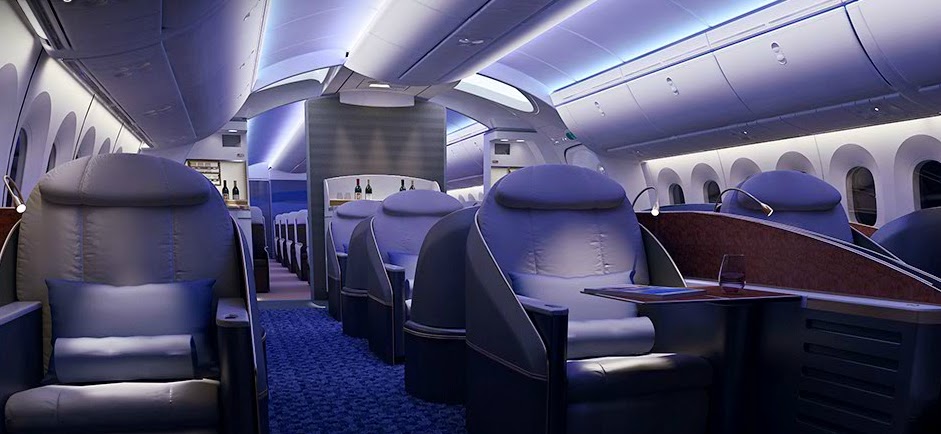
Passengers, even those who will never truly appreciate the freshness of design that the Dreamliner represents, will benefit from the improvements that Boeing has brought to the aircraft design.  Boeing has worked hard on many changes to the passenger experience, including larger windows with fading glass similar in technology to prescription glasses that darken in daylight, helping to reduce glare as well as keeping temperatures down, LED lighting that the cabin crew can change to the airlines color & design goals, and a greater cabin space due to a new fuselage design.  But those improvements are just little extras.  

One of the biggest changes to the passenger experience that the 787 will bring comes from the fact that the 787 is almost entirely built out of composites.  In a traditional metal airplane, such as the 737, cabin air is kept fairly dry to ensure that there are no corrosion issues with the metal structure due to moisture buildup. In the 787, the composite construction doesn't have the same corrosion issues so it can maintain a more standard humidity level.  Additionally, the 787 will be able to maintain a lower cabin altitude so there is less ear popping on the way up to cruise altitude.


 I know that for many, this will be just another airplane that they have to board, to get from here to there, but I think it's more than that.  I have to applaud Boeing for the effort they put into this plane to ensure not only that the airlines are profitable based on improvements in fuel efficiency, but for placing so much focus on the human environment to ensure that we are as healthy and rested when we land as possible.  I guess what I'm trying to say, is that I'm excited, and I sincerely hope that I will have the opportunity to fly in one at some point, and maybe, just maybe if I play my cards right, I'll have an opportunity to fly the great Dreamliner one day as well.  Here's to hoping!! 

Related Links: 

Friday, June 24, 2011

My Take On A Few Aviation Apps

Pilots are continually looking for ways to streamline and simplify cockpit tasks while also maximizing the amount of information available before and during a flight.  While I have only been flying for a few years, my impression is that the number of gadgety options a pilot could choose from began rapidly increasing a couple years ago as GPS, computer, and phone technology became such that an engineer/programer no longer needed to develop both a program and product, but simply a program to be used on existing products.  Apple, while never (to my knowledge) directly involved in aviation tech, has suddenly become a key provider of cockpit toys with the iphone and ipad.

I have been a loyal Verizon customer since I signed my first contract years ago and have been waiting impatiently for Apple to offer an iphone on the V network so I could jump in the happy walled iphone garden.  And now I have.  Now that I have access to the app store, I've been downloading and playing with a bunch of aviation apps and thought I'd pass on what I've found so far.

DTC Duat:
Cost:  Free
http://itunes.apple.com/us/app/dtc-duat/id396959302?mt=8

This is a pretty good little program that fairly well mirrors the user experience of the online Duats system.  What I mean by this is that just like the online version, you get a lot of functionality on a somewhat finicky system without much regard for user interface (UI).  However you do get a solid list of functions including:

  • TFRs both graphical and text 
  • Briefings, route, area, state, and specific
  • Weather including radar, winds aloft, and prognosis charts
  • Flight plans, you can actually file a flight plan with a FREE App! - Best Feature?
  • Flight planner - not user friendly but works
  • Charts, airport info with taxi-way data, approach plates (I don't know if Id use the approach plate on an actual IFR - not even sure that it's officially approved for actual IFR use, it seems a little small for reading while flying, however if you find yourself without the correct chart I'm sure you could make it work).


AOPA:
Cost: Free

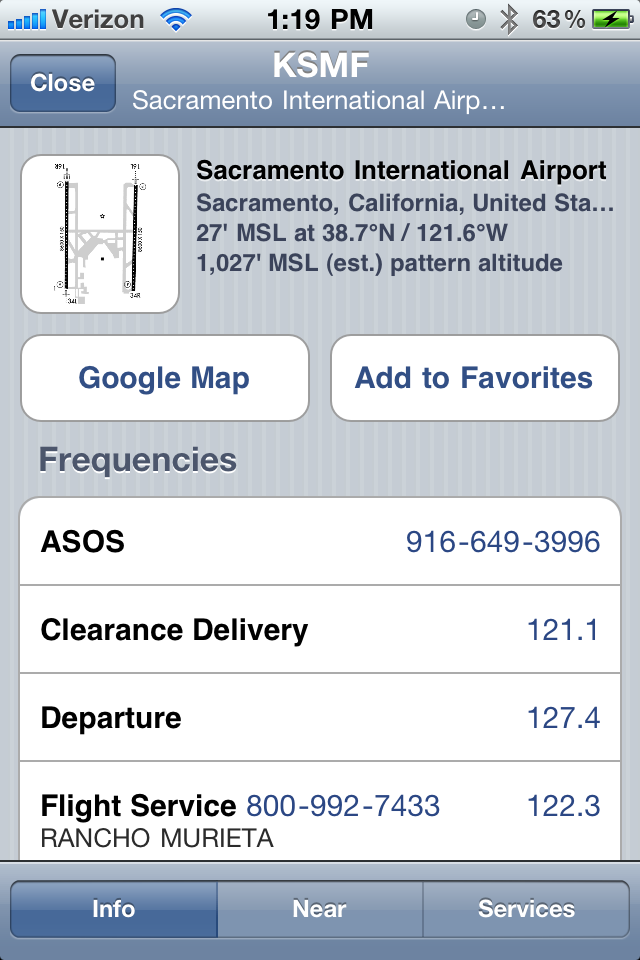
This is a fairly simple App and is a bit more user friendly than the DUATs app for finding airports.  They give really clear information about each airport that you are looking into in terms of frequencies phone numbers for flight service and ASOS, however their airport charts are almost bad with almost no usable info.  Compare the same KSMF chart from AOPA with the one above from DUATs:


The AOPA airports app does a good job of giving you other details about airports you are traveling to including car rental options, local hotels and restaurants as well as FBO contact information.  Had this been a paid app though, I think I would have been disappointed.  At least put the taxi-way designations and maybe a little FBO flag on the chart or something . . .

AeroPlus:
Costs: Free (can you see a trend in my spending patterns?)

This is a simple little app that works really well.  I like it.  You open this app to a map screen centered at your location (assuming you've allowed location services on your phone) with green dots indicating all the weather stations near your location.  if you hover over a location it will indicate some basic wind/weather details and if you click on the airport it will open a little box giving more in depth details:

To sum it up.  If you are looking for a quick weather reference to get a better picture of the weather patterns in your area, this is a perfect app.  You can quickly get an indication of weather on a planned route without needing to know the exact weather station identifiers along the way which is the case with the DUATs program.  If the route is VFR the station will have a green dot, if the station is currently reporting IFR, it will be depicted as a red dot.  If it's in between, an orange dot. 

AeroWeather:
Cost: Free

This is another basic weather program.  The idea here is that you program in a few stations, I'm guessing either local or on a planned route, then the app will list weather and wind in a really easy to read format for each of the airports you have chosen.  Then you can click on any airport to get additional information.  I like that the airport info page shows sunrise and sunset time and really does a good job of listing weather details in plain English. It also has a virtual red windsock on the stations page and VFR/IFR flag for each airport which is handy.  I can't find a mapping feature, however I can imagine that the info provided could still be informative without a map. 


iE6B:
Cost: Free

So here's an app that really provides a ton of functionality and usefulness at a cost I can afford!   Here's a list of its basic functions:

  • Solve for Time
  • Solve for Speed
  • Solve for Distance
  • Wind Correction Angle/Groundspeed
  • Headwind/X-wind
  • Wind Effects
  • Pressure/Density Alttitude (very helpfull)
  • True Airspeed
  • Programable Weight and Balance Template
  • Fuel per Distance
  • Endurance
  • Volume Weight conversion
  • + a host of other unit conversions
The only problem with this app is that the input fields are controlled by a sliding bar not a number pad and the sliding bar is extremely sensitive.  I was trying to get a field elevation of 67 for a density calculation and the closest I could manage was 75 due to the touchy bar. So far I've only used this app for density calculations but I've played with the other features and I think its a fairly quick/easy solution to in flight math.  Note: I've since found that if you tap in the box indicating the selected value (in the wind components image, the "12" would be the value I am referring to) a number pad pops up allowing you to enter a number without worrying about touchy slider input.

 Images: 


Now, there's one almighty app which is essentially the do-it-all handyman of aviation apps and has gained plenty of deserving attention - ForeFlight Mobile.  It has all the features I could ever want (until more come out of course, then I want those too!) from mapped weather, to current GPS enabled flight path data, charts, plates, taxi diagrams,  full weather briefings, flight plan filing and the list goes on.  I can see why pilots are raving about this stuff.  But here's my problem: at $74.99 for a one year subscription, my meager 12-15 mostly LCL attempts at remaining a current pilot hardly justify an Uber expensive app such as ForeFlight, even though I want it so badly.  But here's what I tell myself: ForeFlight is an amazing app, yet the iphone isn't really the right application for the program and while it would be fun to look at on the ground, the screen is a bit too small to  make it really useful in the air.  When I'm able to afford both the ipad, and more frequent cross country flights, I think spending the extra money each year would be well worth it.  For now, I'll satisfy my appetite for igagety toy apps by downloading ten different cheap or free apps and hope they together will come close to doing what ForeFlight is capable of. I'll note that Garmin also has an app called Garmin Pilot My Cast which is supposed to have similar functionality.  I downloaded ForeFlight on my iphone but planned the timing wrong as I wasn't able to fly during the 30 day free trial period that they offer. But from the ground, it seems user friendly and full of functionality.  

So what's my overall take on the igadgets?  The many weather services available for the iphone make on-the- go and away from the computer weather checks much smoother and quicker.  I'd note that when in doubt, you should always make a phone call to 1800 WX BRIEF to speak with a real human, however the visual sense of the weather in your region via the various apps can really help to give you a perspective of current and forecast conditions as you are getting closing to your flight time.  And the iE6B is a really nice tool that makes my old rotary phone tech E6B seem clunky and outdated.  I have yet to use any of these apps in the cockpit, but I'll make sure to send an updated if I have the opportunity to use these on an actual flight.

While not an actual aviation tool, I downloaded the LiveATC app which is a great little app if you ever feel like listening in on any of the major tower frequencies.  Fun, mostly pointless, but still somehow worth the 3 bucks they charge for the app.  Check it out: