Thursday, April 7, 2011

Pilot Takes His Piper Surfing

A 24 year old pilot was flying low along the beach near the Kennedy International Airport and was in contact with Air Traffic Control when he asked the controller if it would be OK to land the plane on the beach.  The controller essentially told him NO as it was a public beach and it would only be acceptable under emergency conditions.  The pilot then mentions that his engine may be running a "a little teensy bit rough" and he would be doing a precautionary landing on the beach - but it's not an emergency.  The controller responds by informing the dim whittled pilot that his request actually constituted an emergency and the controller began alerting the authorities of an emergency beach landing.

Listen to the ATC audio here:
http://www.avweb.com/other/piper-32nd_beachlanding_LiveATC-net.mp3


This guy seems so arrogant in his communication with ATC using language that is completely inappropriate especially in the congested airspace near Kennedy International "I'll get off your grill."  Once on the ground, this pilot refers to the Flying Wild Alaska TV show on the Discovery Channel and says that he was inspired by the off airport landings depicted on that show and thought he'd try is own off airport landing on the beach.  Does this guy realize that the bush pilots spend years training in backcountry flying, only slowly working their way up to making well planned off airport landings, they didn't just one day think, "it would be a great idea to land in the ocean."  What this kid has done, is make both young general aviation pilots as well as highly trained backcountry bush pilots look bad in an act that can be described as both brash and childish.  I hope the general public understands that the aviation community is embarrassed by this pilot and most pilots would never dream of doing something like this.

While most pilots are working hard each flight to ensure they are flying safely and within the limits of their ability and knowledge, this kid is out there practically cracking jokes to the controller by saying "what if I want to hide from you" and seems to think that flying is just a game. Look, I think a lot about how we can get more young pilots involved in aviation as fewer and fewer youth are taking to the skies, but this is not the type of person we need in the sky.  He endangered himself as well as his two passengers and clearly didn't consider the possibility that people could be out on a public beach and decided to land in-spite of the ATC warning that landing on a public beach was not legal.  I hope for the sake of this young pilot, that he had enough with flying and was simply looking for an opportunity to have his certificate taken away - because I doubt he will ever fly again after a stunt like that.

I guess this is similar to the issues involved with video games and guns.  It can be fun to play a video game with guns, as it is fun to watch a bush pilot land on a river bed, but most people can tell the difference between what is happening on the screen, and the actions that are OK in normal life.  Using guns is an acceptable practice if the person using the gun is being responsible and using common sense, and also has practiced using the gun in a controlled environment.  Just because you see it happen on a screen doesn't mean you should try it yourself and I seriously hope that people don't criticize the show as being a bad influence on pilots.  I've watched the show but would never think it would be a good idea to just land on the banks of Folsom Lake for instance.  Just stupid.  Stupid kid.

Here's a tip for anyone interested in trying their first off airport operations, go take some bush lessons before you "try this at home," here are some options:

http://www.abovealaska.com/bush.htm

http://www.andoverflight.com/information_bushpilot.html

This way, you can be like a Flying Wild Alaska pilot but not endanger people in the process.

"There are old pilots, and there are bold pilots, but there are no old - bold pilots"


Wednesday, April 6, 2011

Flying With Jeanine on a Windy Spring Day

Thanks for coming up with me Jeanine, it was a fun flight!


This was one of those flights that really makes me think about the decision making process a pilot needs to work through to decide it's safe to fly.  Because there are so many risks inherent in flying an airplane, we as pilots have to pay extra attention to ensure that we are controlling and managing those factors that we can affect or simply decide not to fly if the factors are beyond our ability and experience.  On this day, wind was the significant risk factor with morning wind blowing from the north at around 17 miles per hour gusting to nearly 30 miles per hour - while not strong enough to knock any trees down, certainly enough to blow around a little Cessna 152 making a safe controlled landing more than a small challenge and probably not safe.  Now, you already know I ended up going flying, so how did I come to decide that it was safe?

Chapter one of my Private Pilot Handbook (the pilot version of a college textbook) jumps right into the topic of aeronautical decision making (ADM) and may be one of the elements of flying that can really keep a pilot up at night before a flight where weather is a significant factor.  One of the elements of ADM is communication. For me, I am trying to, and slowly getting better at communicating with those who are flying with me yet am still trying to find the balance of keeping them informed, yet not scaring them with too much information.  In this case, I told Jeanine that we could drive out to the airport, but there was a chance that we'd just stay on the ground because of the wind.  I don't think that's enough communication though, I also try and reassure that a decision to fly will include a good margin of safety and in general, I want to make sure my passengers know they have the power to veto the flight if they are not comfortable.

The wind outlook for the afternoon indicated that the gusts should quickly die down in the afternoon and become steady at 10 - 12 mph.  To help myself out before I left for the airport, I decided that with my level of experience with wind, and the weight and performance of the airplane, that I would not take off if the gusts were above 21 mph, a way to make the go/no-go decision much easier once at the airport, and also a decision that my passenger would have an easier time visualizing as well.

In many ways, the final decision comes down to a combination of the actual weather data - such as my choice not to fly with gusts above 21 mph on this day, but also a proper amount of gut instinct.  Quality gut instinct really comes from experience in similar conditions, which is tough as no flight has exactly the same factors at play.  So you try and separate the factors into individual items which you've seen before and can more clearly analyze.   It's standing at the airport and watching the windsock to see if the wind is generally steady in one direction, or blowing rapidly back and forth, it's getting a second opinion from other pilots at the airport,  it's looking at the sky and the trees to see if birds are having trouble flying, and reading and re-reading the local weather reports, it's taking it slow to build a case for, or against the flight.  I sometimes ask myself if I have to evaluate a flight this much, is it worth the risk - should I just not go?  Sometimes the answer is not to fly.  But in a way, I hope that each time I go flying, I am paying this much attention to all the factors of flight in an attempt to always make an informed and safe decision.  So I took my time at the airport and made sure I was at no point determined to fly as that's a sure way to make the wrong choice.

As it turns out, by the time we got to the airport things were looking better, the wind was blowing steady at 13 mph gusting 20 mph, a flight instructor had just come back from a flight in another 152 and reported that it was smooth up above, and the windsock was blowing steadily from 340 degrees on a 350 runway.  The risk factors were not outside the envelope and by spending time coming to a decision, and by keeping my passenger informed of the risks and (hopefully) giving her confidence that I'd only decide to fly if the risks were within my experience level and the capability of the aircraft, that we could have a great flight without her needing to worry about her own safety.  In this case, I decided to go. 

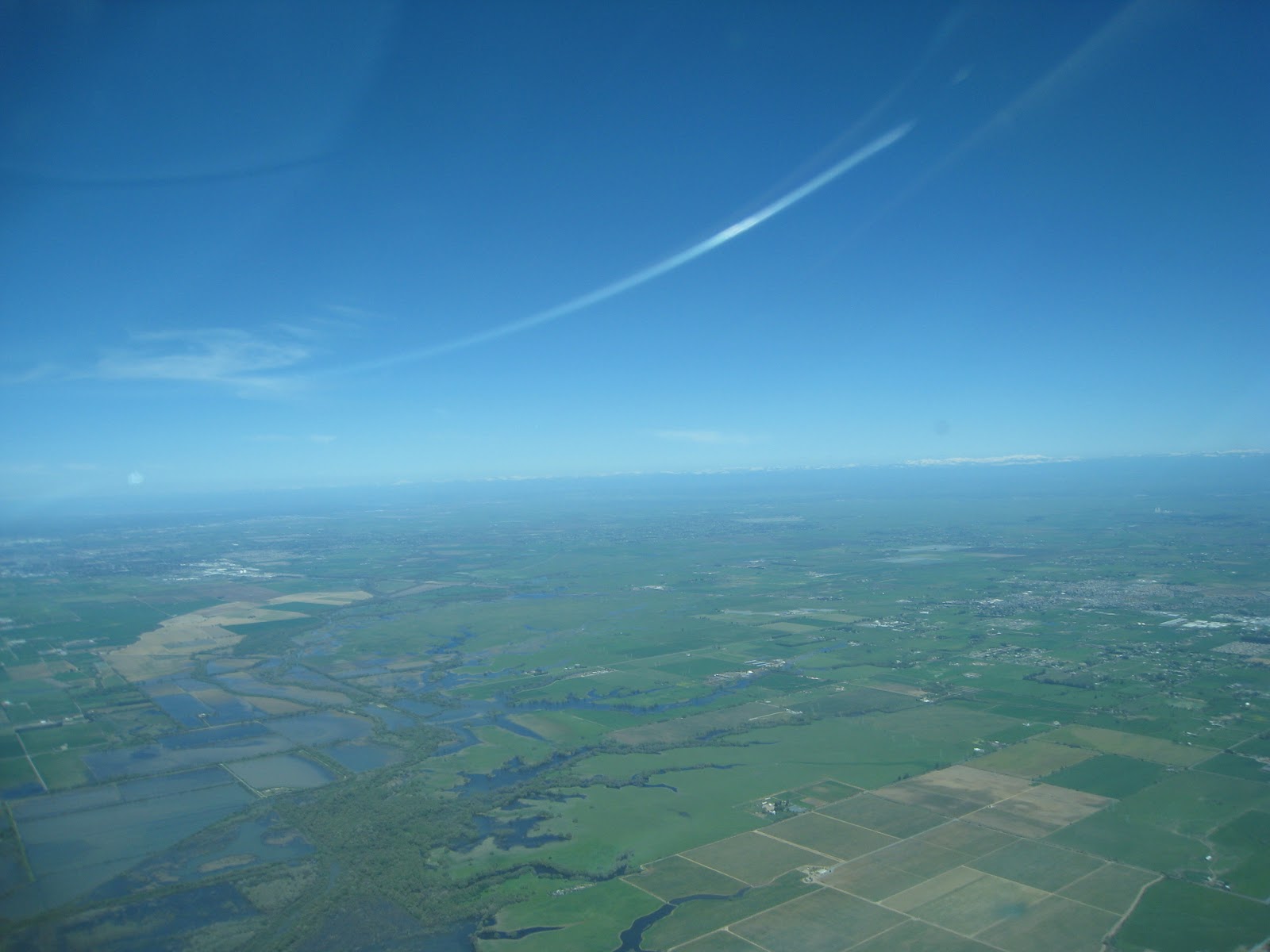
As it turned out, it was a smooth takeoff leading to a surprisingly smooth flight given the amount surface level wind.  I thought that this flight was actually one of the more beautiful local flights I've been on, with about the greenest farms I've ever seen, a completely clear sky with a clear view of the snow packed Sierras, a full Yolo flood basin below with the wind blowing across the water in a way that looked like little glimmering streamers in the water, just beautiful stuff. Once I was in the air and could tell it was going to be a beautiful and smooth flight, I momentarily felt embarrassed that I had approached the flight with such caution, but like I said, I really need to look at every flight with the realization that there are always risks involved in flying an airplane, and to do your best as a PIC is to understand the factors at play for each flight and attempt to make safe conservative decisions each time you head to the airport.


And now enough with the boring stuff.  Here are the photos:


Tuesday, March 15, 2011

American Airlines Goes On A Diet

Airlines are taking huge steps to cut fuel consumption as fuel prices start inching up. Airlines are currently running on such slim profit margins that even slight increases in fuel costs can nearly cripple an airline if unprepared for the increase.   Airlines across the board have begun jacking up prices and have already started grounding aircraft to reduce capacity and maximize the usage of the current aircraft (read: extremely full aircraft).  I’ve even heard that some airlines are toying with the idea of offering variable rate tickets to transfer some of the risk of increasing oil prices on to the passenger – although I don’t know who in their right mind would buy such a thing?  I guess people bought variable interest home loans so maybe they will do the same for an initially cheaper airline ticket.

In addition to increasing fares and grounding aircraft, American Airlines is working especially hard to be prepared for increased oil prices.  They have put together an entire program called Fuel Smart consisting of fuel saving measures that individually may not have a significant impact, but across a fleet of hundreds of aircraft will begin to add up.  AA is currently working on modernizing a fleet of older Boeing 737 aircraft with weight a primary concern.  Here are the current 737 airplane weight saving changes:

  • Replacing all 19,000 drink carts with new 12 lb lighter carts
  • Testing a new paint coating that is meant to improve airflow over the airplane body
  • Removing seat back phones and their heavy wiring
  • Installing lighter seats
  • Lighter carryon luggage bins
  • Lighter TV monitors
          (not specifically related to the 737):
  • Buying more tugs to tow airplanes from terminals to hangars for when maintenance or testing is needed instead of starting the jet engines to taxi

All told, these improvements add up to and estimated $370 million in savings relating to fuel burn.  I’m not sure how that relates to their overall operating budget but I’m sure it makes a difference.

This story gave me an idea though.  AA is investing in tugs to pull aircraft from the terminal to hangars and have apparently done the math to figure out that the extremely expensive tugs are still less expensive than taxiing the aircraft to maintenance hangars.  In fact, AA saved 3.6 million gallons last year just by towing instead of taxiing to maintenance hangars.  I started to think about the savings and wonder, wouldn’t airlines save even more money by towing the airplanes to the run-up area for takeoff? Especially if the airplane is delayed for takeoff. 

Imagine a tow-taxi procedure in operation at the larger airline hubs such as JFK, Atlanta, Dallas, and Chicago among others where departure delays regularly drag on up to three hours, if every jet sat with engines off, being both tugged and cooled via the much cheaper to operate Diesel or electric Tug engine, couldn’t that save the industry millions if not billions of fuel dollars?  I did a little poking around online to see if the idea has already been presented and sure enough, it’s out there - sort of. 

Apparently Virgin Atlantic had been working on this very idea as part of the airlines various “green” initiatives.  Virgin claimed that towing aircraft to a starting pad at the end of the runway could save two tones of CO2 per flight if it normally takes a non delayed airplane 10 minutes to taxi. Obviously a conservative estimate.  The project was gaining steam in 2006 with the first 6 flights starting with a tow to the runway when Virgin received information from both Boeing and Airbus stating that repeatedly towing airplanes at full gross weight would weaken the landing gear and potentially shear it off after repeated full capacity towing.  Additionally, they stated that they would not offer product support to aircraft that had been towed at full capacity. Virgin has since stated that the towing initiative is indefinitely grounded.

My question is this:  If reducing a few jet powered trips to the maintenance hangar saves AA 3.6 million, easily justifying the investment in new tugs, wouldn’t the drastic reduction in fuel consumption from an entire airline industry towing their airplanes to the runway be enough of a savings to justify investment in stronger landing gear that could handle the stress of towing a full aircraft?  I guess I am just surprised that when one airline is looking at even small weight reductions as a means of saving fuel, that there wouldn’t be enough industry pressure on Boeing and Airbus that they could find a solution if the airlines collectively requested a fix.  As it is, I read airline news on a daily basis, and have been for around three years, and had never heard of an airline talking about this solution until I looked for it.  As a note, airlines are not blind to the issue of taxi fuel burn as most if not all request that their pilots taxi using only one engine to reduce consumption, but even on one engine, the fuel burn is significant.

Oh well.  And I though I had a little jewel of an idea too!! 

Here are my links:


Monday, March 7, 2011

Why is the Airline Industry Doing so Poorly?

This is an article I found in the December/January edition of Flightline, the Allied Pilots Association union publication, I found it fairly clearly described some of the reasons behind our poorly performing airline industry.

By Captian Robert Herbst:


One of the most frequent questions I get asked during
interviews is: "Why is the airline industry doing so poorly?"
There can be a long list of answers to that question depending
on if you are the passenger buying a ticket or the employee
working for an airline.
The question actually has an easy answer. Contrary to what
politicians frequently attempt to suggest, airfares on average are
simply too low to cover the ever-increasing and required costs
for safe air travel.
In 1990, the average passenger cost to fly one mile in the
United States was 13.4 cents. Twenty years later, the cost was only
12.7 cents per mile. During the last two decades, the average U.S.
domestic airline passenger fare measured on a per mile cost basis
stayed in a range of 12.0 cents to 14.6 cents. Note: This is revenue
to the airlines and does not include government taxes, fees, security
charges etc. that are now approaching 30 percent per passenger fare.
Comparing 2009 with 1990, the cost of air travel decreased
by 9.9 percent while the Consumer Price Index for inflation
increased by 64.1 percent (cost for air travel excludes government
taxes and fees).
If airline passenger travel costs had kept up with CPI inflation
over the last 20 years, the average fare to fly one mile in 2009
would have been 22 cents per mile, a 59 percent increase over
the actual cost.
Here are a few staggering statistics for the U.S. airline industry:
• In 1990, there were 460 million passengers. In 2009, there
were 704 million passengers.
• In 1990, there were 546,000 airline employees. In 2009,
there were 536,000 airline employees.
• The U.S. airline industry has lost money in 12 of the last 20
years and accumulated a net loss of approximately $29
billion (excludes airline bankruptcy and reorganization
write-downs).
• The price of jet fuel for 2009 was at a four-year low and still
240 percent higher than the airlines paid in 1990.
• Since Jan. 1, 1990, there have been 98 U.S. airlines file
for bankruptcy.
After 20 years of on and off airline industry growth, there
are now 2 percent fewer airline employees responsible for a 53
percent increase in passengers. The numbers make it easy to see
why there are so many complaints against the airline industry.
Sometimes the old cliché: “You get what you pay for,” has
true meaning.
The chart below provides average passenger revenue per
mile for U.S. airlines, commuter rail, and intercity/Amtrak travel
as compared to the Consumer Price Index from 1990 to 2009.

Photobucket

Thursday, March 3, 2011

Night Flight with Joel

So I didn't exactly make it out to the airport before sunset, but I still managed to go flying!  What's more, I was able to get my brother Joel out for the flight which is exciting.  While he had been flying with me before as a rear seat passenger, this was his first time in the front where he could do some of the flying himself.  Here are some of the photos from this evening:


Photobucket

Photobucket

Photobucket

It's hard to tell, but Joel is currently flying the airplane at around 3,000 feet!!
Photobucket

Photobucket

In addition to quickly picking up how to make controlled turns in the aircraft, Joel also managed to smoothly take off at the Yolo County airport with only a little rudder assistance from me, good job Joel!!

I want to go fly in that sky!!

Photobucket

We finally got some good weather today after seemingly weeks of bad weather keeping me on the ground, and just look at that blue sky!!  A pilot couldn't ask for much better weather than we have today, cool temperatures and only the slightest breeze, I have a serious itch to get up there.  It's been since January 14th since I last flew which feels like way too long in my book.  Plus, I've been doing mostly night flights which is great fun in it's own way, but common, blue sky like today deserves to be flow in!!  We'll see, maybe I can pull myself together and make an early evening flight happen.

Tuesday, February 22, 2011

Rest Rules Could Create Pilot Shortage?


(From a recent AVweb news article)

American Airlines says proposed rules intended to reduce pilot fatigue would require it to hire an additional 2,325 pilots at a cost of $514 million annually, and seemed to suggest the industry-wide effect could be crippling. The rules would effectively decrease maximum time on duty for pilots. In November, American offered public comments on the rules, saying "if AA needs 2,300 more pilots to meet the proposed rules, other certificate holders will need many additional pilots, too." Stakeholders also claim that the regulation's cost will be substantially higher than the FAA's estimate of $1.25 billion over 10 years. 

The Air Transport Association says the rule would cost more than 15 times that figure. As for the total number of pilots needed to meet the requirements of the bill, American said, "The industry figure will be so large as to raise the question of from where they all will come." American wasn't the only carrier to express concern.

Southwest commented on the proposal, saying "we feel than many of the rule changes will impact our operation as dramatically, if not more so, than the impact on any other carrier." The proposed rules call for nine hours rest between shifts and 30 consecutive hours away from work, each week. The proposal arose with support of people who lost family members in the crash of Continental Connection Flight 3407. There were no survivors of that flight, so the exact role of fatigue is unknown. However, the investigation found that neither member of the cockpit crew had slept in a bed the night before the crash, both had long commutes, and fatigue may have affected crew performance. In February 2010, NTSB Chairman Deborah Hersman called the crash "an opportunity to reexamine fatigue in aviation."

Fatigue in aviation has been on the NTSB's Most Wanted List of Transportation Safety Improvements since 1990. The FAA accepted comments on the proposed rules (PDF) through Nov. 15, 2010.


My comments:

Reduced safety due to short crew rest periods and long duty hours has been a major concern especially after the crash of Colgan Air Flight 3407 that killed all on board.  Crew rest was cited as a possible contributing factor as neither flight crew member had what many would consider to be adequate sleep prior to the flight.  

What I hear in this news story is an airline industry unwilling to make small changes to ensure the public receive safe air transportation.  I understand that decreasing the length of time a pilot is allowed to remain on duty, while also increasing crew sleep periods will require an added expense to the airlines, but no airline is being singled out to carry this burden. Rather, the ruling would affect the entire airline industry and the cost would  be passed down to the consumer.

While the airline industry at first, and later consumer advocacy groups may balk at an increase in cost, the public outrage that was voiced immediately after the Colgan crash over the extreme personal loss following a zero survival crash, should be enough to remind us that the consequences of industrywide pilot fatigue are far to great to warrant complaints over a small increases in ticket prices.  

Finally, the airline industry is expressing concern over an inadequate supply of pilots to support a change like this.  In fact, there is likely to be a significant pilot supply issue over the next 10 years.  Here are the numbers, airline industry experts expect airline passenger traffic to double by 2020, mainline carriers are expected to need to train 17,000 pilots a year between now and 2020 - roughly 3500 more per year than we are currently training to fill seats vacated by retiring boomers, as well as the pilot seats of roughly 16,000 aircraft on order through 2020. 

The problem is, it's hard to attract smart college graduates to the airline industry when entry level pay into a regional airline remains somewhere between $20,000 and $25,000 per year, especially when most airlines are willing to publicly balk at the idea of increasing pilot quality of life by increasing rest periods and reducing duty duration to a level that doesn't cause regular and often life threatening pilot fatigue.